A Planet We Thought We Knew
Since the Viking landers touched down in 1976, humanity has maintained a robotic presence on Mars almost continuously. We have photographed its canyons, sampled its soil, drilled its rocks, and watched its dust storms swallow the horizon. Two rovers are active on the surface right now. We know more about Mars than about any other world beyond Earth.
And yet the planet keeps surprising us.
Lightning — one of the most fundamental atmospheric phenomena on Earth — had never been detected on Mars. Not for lack of trying. The European Space Agency's Mars Express spent five years scanning Martian dust storms for any hint of electrical activity and found nothing. The ESA's Schiaparelli lander carried a dedicated instrument to measure atmospheric electricity; it never had the chance to use it, destroyed in a software failure during descent in 2016. Decade after decade, the search came up empty.
Then NASA's Perseverance rover, while doing something else entirely, heard something it wasn't supposed to hear.
The Instrument That Wasn't Looking
Perseverance carries an instrument called SuperCam — a laser-based rock analyzer that fires pulses at Martian rocks and reads the light and sound produced by the resulting plasma to determine chemical composition. It is a geology tool. It was not designed to detect lightning.
But SuperCam has a microphone. And that microphone, in addition to recording the sounds of laser impacts on rock, was recording everything else around it.
A team of scientists led by Baptiste Chide of the Institut de Recherche en Astrophysique et Planétologie in France spent months analyzing nearly 45 months of SuperCam audio data. What they found, buried in the recordings, were 55 short acoustic pops — sharp, isolated crackles that did not match any known sound produced by the rover itself. The majority occurred during dust storms or inside dust devils.
The team worked systematically through every alternative explanation. Could it be the rover generating the sound internally? No — it matched nothing in Perseverance's catalog of operational noises. Could it be a dust grain striking the microphone directly? Possible, but that explanation couldn't account for simultaneous electromagnetic interference detected alongside the sound.
To test their hypothesis, they built a replica of the SuperCam instrument on Earth, recreated Martian dust storm conditions in a laboratory chamber, generated static charge by rubbing particles together, and recorded the result. The signal was remarkably close to what Perseverance had captured on Mars.
Their conclusion, published in Nature in November 2025: the 55 pops were most likely caused by electrostatic discharge — lightning, in the Martian sense of the word.
"Even after decades of careful observation, Mars continues to surprise us. This accidental discovery has opened research pathways we didn't know existed."
A Second Line of Evidence
Three months after the Nature paper, a separate team reinforced the finding from an entirely different angle.
Researchers at Charles University in the Czech Republic, analyzing a decade of data from NASA's MAVEN spacecraft in Mars orbit, found something called a whistler wave — a low-frequency radio signal that travels along magnetic field lines and is considered a telltale signature of lightning. On Earth, whistler waves are well-documented. They have also been detected at Jupiter, Saturn, and Neptune, where lightning is abundant.
They had never been detected at Mars — until now.
Mars lacks a global magnetic field; its internal dynamo shut down billions of years ago. But it retains localized crustal magnetic fields, particularly in the southern hemisphere, remnants of an ancient magnetosphere now frozen into the rock. The researchers found evidence that a whistler wave had propagated along one of these crustal field lines — consistent with a lightning discharge occurring in a dust storm below.
The signal lasted 0.4 seconds. Out of more than 100,000 data points from MAVEN, only one such event was found. But the geometry required for such a signal to be detectable is highly specific — MAVEN would need to be positioned precisely above an active storm with the right magnetic field geometry. The rarity of the detection likely reflects the difficulty of the observation, not the rarity of the phenomenon.
Two independent datasets. Two independent teams. Both pointing to the same conclusion.
"That fleeting signal, combined with the Perseverance findings, tells us with near certainty that lightning exists on Mars — we simply needed to know exactly where and how to look."
Not What We Picture
Martian lightning is not the dramatic column of electricity splitting a storm-black sky. Mars's atmosphere is more than a hundred times thinner than Earth's — the towering storm clouds that generate terrestrial lightning cannot form there.
What Martian lightning appears to be is closer to the static shock you receive when you walk across a carpet in socks and touch a metal door handle. Small, sharp, and localized. Generated not by colliding ice crystals in storm clouds, but by colliding dust particles in the planet's constant swirl of storms and dust devils.
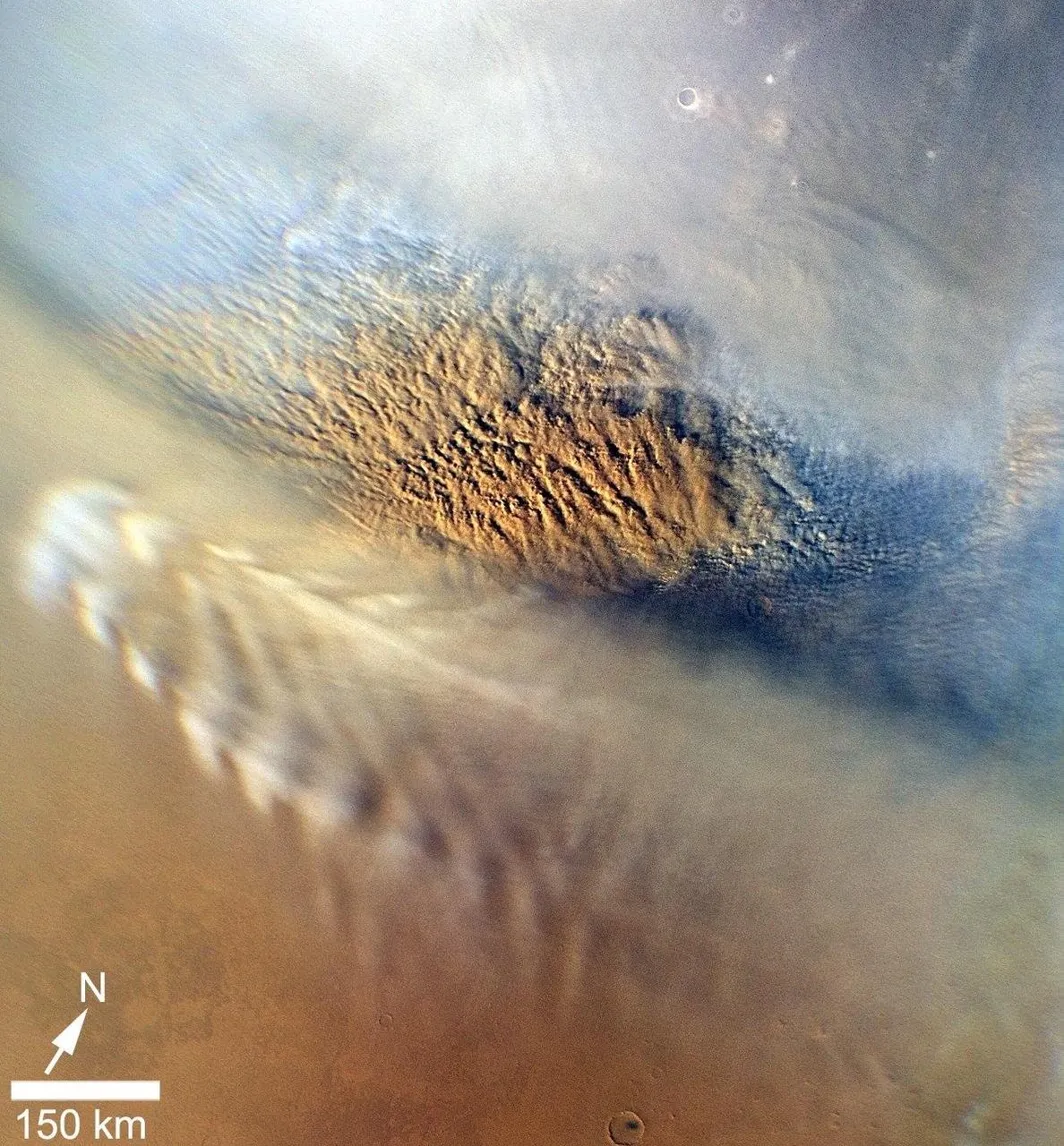
Mars has no shortage of those. Wind lifts dust into columns up to 19 kilometers tall. Scientists estimate as many as 145 million dust devils may roam the planet's surface on any given day. And several times per Martian decade, regional dust storms merge into global events that blanket the entire planet for months — the same kind of storm that ended NASA's Opportunity rover in 2018, when accumulated dust on its solar panels shut it down permanently.
All of that spinning, colliding dust generates charge. And charge, when it accumulates beyond what the thin air can contain, discharges.
What It Means for the Chemistry of Mars
Lightning on Earth does more than illuminate the sky. It is chemically active — energetic enough to break nitrogen and oxygen molecules apart, allowing them to recombine into nitrogen oxides that dissolve in rainwater and enter the soil as natural fertilizer. It produces ozone. And some scientists believe lightning may have played a role in the origin of life itself, converting atmospheric gases into the organic molecules — amino acids, RNA precursors — that eventually became biology.
On Mars, the implications run in the opposite direction — and they are troubling for the search for life.
Mars is saturated with highly reactive oxidizing compounds: hydrogen peroxide and perchlorates, detected across the surface by multiple missions over decades. Scientists have long known these oxidants are present. What they have struggled to fully explain is where they come from.
The newly discovered electrostatic discharges provide a plausible mechanism. Even weak Martian lightning carries enough energy to break molecular bonds and drive chemical reactions — including the production of precisely the oxidants found in the Martian soil.
These oxidants are aggressive. They break down organic molecules on contact. If Mars ever harbored life — and the geological evidence for ancient liquid water makes this a serious scientific possibility — the chemical traces of that life may have been systematically destroyed by billions of years of electrostatic chemistry.
The implication for future missions is direct: surface samples are likely contaminated. Any credible search for Martian biosignatures must go underground — into rock layers and sediments buried deep enough to be shielded from the oxidizing surface environment.
What It Means for the Humans Going There
NASA and SpaceX both have active plans to send humans to Mars within this decade. SpaceX has targeted initial uncrewed Starship landings in 2026. NASA's Artemis program, focused on the Moon, is explicitly designed to develop the technologies needed for eventual Mars missions.
The discovery of Martian lightning raises a practical question those mission planners now need to answer: what does this mean for crew safety?
The direct risk is low. Martian electrostatic discharges are far too weak to injure a human. The first person to stand on Mars will not be struck down by lightning.
But small, frequent electrical discharges could interfere with sensitive equipment. Communications systems, scientific instruments, and life-support electronics are all vulnerable to electromagnetic interference. And the related problem of electrostatically charged dust is already documented and serious — charged dust adheres persistently to solar panels and instrument surfaces. NASA's InSight lander lost power completely in December 2022 when accumulated dust coated its solar panels beyond recovery.
Engineers designing Mars hardware will now need to account for an electrical environment they had previously assumed was benign. Shielding, grounding systems, and operational procedures around dust storms all require reconsideration in light of what Perseverance heard.
What Comes Next
The 55 events Perseverance detected are a beginning, not a conclusion. A sample size of 55 over 45 months, on a planet where hundreds of millions of dust devils occur daily, is vanishingly small. The true scale of Martian electrical activity remains unknown.
Future missions will need to address this directly — with dedicated instruments, not accidental microphone captures. The ESA's Rosalind Franklin rover, currently scheduled for launch in 2028, and India's ISRO Mars lander planned for 2030, will both carry more sophisticated atmospheric sensors. Designing those instruments with electrical detection as an explicit objective is now a scientific priority.
What Perseverance has given us is not an answer. It is a confirmed question — one that changes how we understand Martian weather, Martian chemistry, the search for Martian life, and the safety of the humans who will eventually walk there.
A small pop in 45 months of audio data. A 0.4-second radio signal in a decade of orbital measurements. Between them, they have opened a window onto a Mars more electrically alive than anyone expected.
Mars has been studied for decades. We thought we understood its silences. It turns out one of them wasn't silence at all — it was static.
Frequently Asked Questions
Has lightning really been detected on Mars?
Two independent lines of evidence now support the existence of electrical discharges on Mars. In November 2025, analysis of Perseverance rover audio data published in Nature identified 55 electrostatic pops consistent with lightning. In February 2026, a separate team found a whistler wave in MAVEN orbital data — a radio signal considered a signature of lightning — traveling along Martian crustal magnetic field lines.
What causes lightning on Mars?
Unlike on Earth, where lightning is generated by colliding ice particles in storm clouds, Martian electrical discharges appear to be driven by colliding dust particles in the planet's frequent dust storms and dust devils. As particles collide and exchange electrons, charge builds until it discharges — similar to the static electricity generated by walking on carpet and touching a metal surface.
How powerful is Martian lightning?
Much weaker than terrestrial lightning — more comparable to a static shock than a full electrical discharge. Mars's thin atmosphere, more than 100 times less dense than Earth's, cannot sustain powerful discharges. However, even weak discharges carry enough energy to drive chemical reactions in the Martian surface and interfere with sensitive instruments.
What does this mean for the search for life on Mars?
The discovery suggests that electrostatic discharges are producing the oxidizing compounds — hydrogen peroxide and perchlorates — found across the Martian surface. These compounds destroy organic molecules, meaning any chemical evidence of past life may have been degraded or erased. Future life-detection missions should target deep subsurface samples shielded from surface oxidation.
Is Martian lightning dangerous for astronauts?
Direct strikes are not considered dangerous — the discharges are too weak to injure humans. However, frequent small discharges could interfere with sensitive electronics and communications equipment. The related problem of electrostatically charged dust adhering to solar panels is a documented operational hazard already responsible for the loss of the InSight lander in 2022.
What instrument made the discovery?
NASA's SuperCam instrument on the Perseverance rover — a laser spectrometer designed for geological rock analysis — carries a microphone that incidentally detected the electrical pops. The discovery was not planned. The research was led by Baptiste Chide of the Institut de Recherche en Astrophysique et Planétologie in France and published in Nature in November 2025.
Sources
- Chide, B. et al. "Acoustic detection of electrostatic discharges on Mars by the Perseverance rover." Nature, November 2025.
- Charles University research team — MAVEN whistler wave detection. February 2026.
- NASA Perseverance Mission — SuperCam instrument documentation. mars.nasa.gov
- NASA MAVEN Mission — magnetospheric and atmospheric data archive. nasa.gov
- ESA Mars Express — atmospheric electricity search results.
- Cover image: NASA/JPL-Caltech — Perseverance rover on Mars. Public domain.