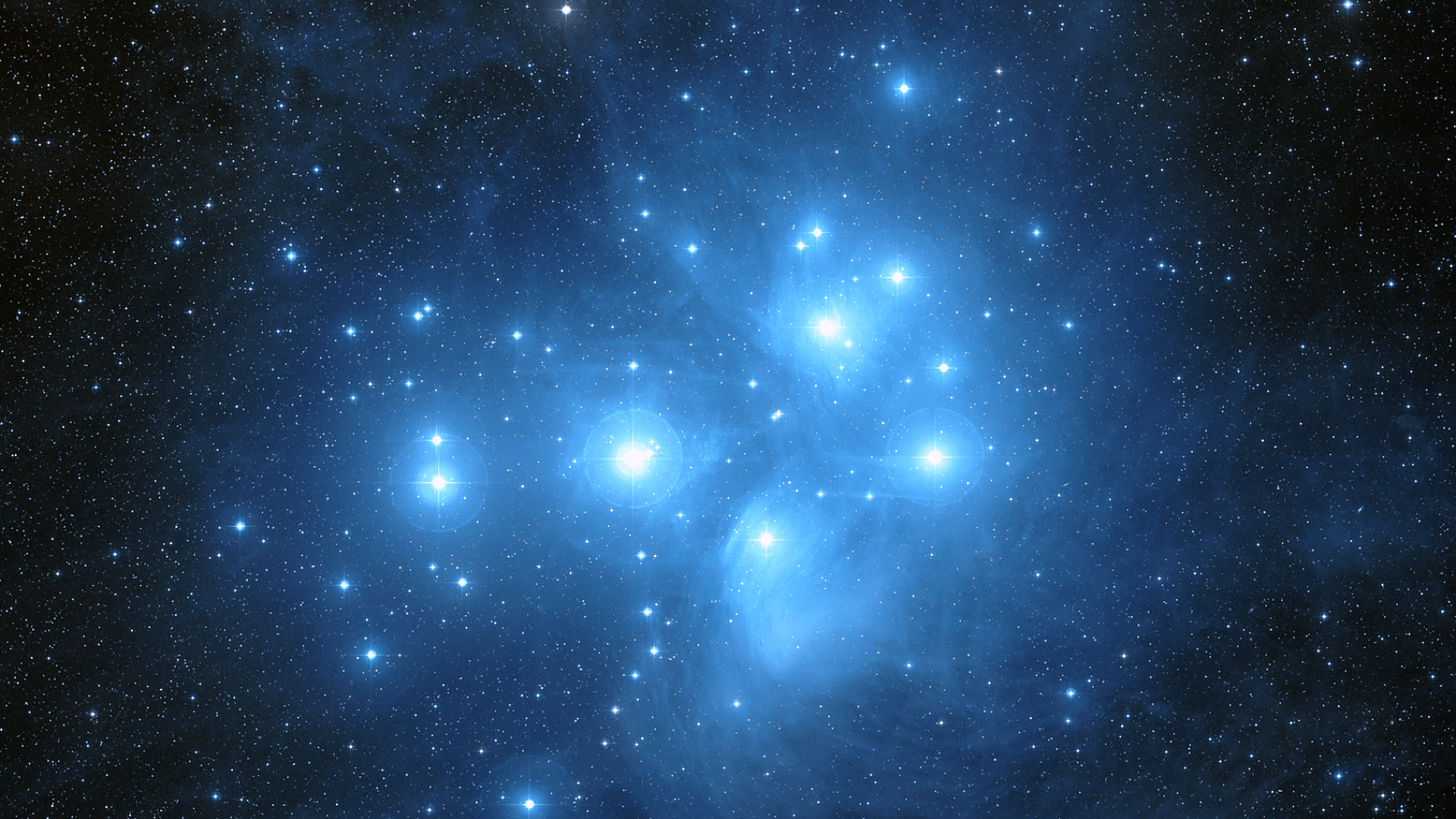
A Sky That Doesn't Exist Yet
Imagine standing on a planet four hundred and forty-four light-years from Earth. The sky overhead is not the familiar one. There is no Big Dipper, no Orion. The Sun is a distant pinprick, indistinguishable from any other yellow star.
What dominates the sky instead is a constellation of more than a thousand stars, packed into a volume only seventeen light-years across. Several of them shine with the brightness of small moons. The brightest, a blue-white giant called Alcyone, throws sharp shadows on the ground at midnight.
This sky does not currently exist. There is no confirmed planet anywhere in the Pleiades star cluster, and there may not be one anywhere in it for hundreds of millions of years to come. But on at least one star within the cluster, the raw material is already in motion.
This is not a thought experiment about what could be. It is a question about what will be.
A Family Born from a Single Cloud
The Pleiades — Messier 45 in the catalog, the Seven Sisters in mythology, Subaru in Japan — is one of the closest open star clusters to Earth. Recent measurements from the European Space Agency's Gaia satellite have refined its distance to roughly 136 parsecs, or 444 light-years, with an uncertainty of about 1 percent.
The Pleiades are young by cosmic standards. Multiple independent dating methods — main-sequence isochrone fitting, lithium depletion in the cluster's lowest-mass members, gyrochronology — converge on an age in the range of 100 to 125 million years. The most precise modern estimate, from a 2015 reanalysis of the lithium depletion boundary published in The Astrophysical Journal, places the cluster at about 112 million years old.
Every star in Messier 45 was born from the same molecular cloud over a relatively brief interval. They are siblings in the strictest astronomical sense — same composition, same age, same starting velocity vector through the galaxy. Modern Gaia surveys have identified roughly 1,300 stars as confirmed members of the cluster today, with hundreds more candidates in the surrounding stellar streams the Pleiades have shed over time.
The cluster is gravitationally bound, but only loosely. The stars are spread across about 17 light-years, with a denser core spanning roughly 8 light-years. This is enough to keep them moving together for the time being. It is not enough to keep them together forever.
More than a thousand stars, born from one cloud, traveling as a family for the time being — until gravity loses its grip and they scatter into the galaxy.
Alcyone, the Lighthouse
If you stood on an imagined Pleiades planet and looked up, the most prominent object in the sky would not be a sun. It would be Alcyone — known to astronomers as Eta Tauri, designation HR 1165 — the brightest member of the cluster.
Alcyone is what stellar classification calls a B7IIIe star. The "B7" describes a hot blue-white surface temperature of about 12,300 kelvin, more than twice as hot as the Sun. The "III" denotes a giant in the late phase of its hydrogen-burning life. The "e" — for emission — is the consequential letter.
Alcyone is what astronomers call a classical Be star. It rotates so quickly that it has flung a disk of gas off its own equator. The star's projected rotational velocity, derived from the Doppler-broadening of its spectral lines, is approximately 149 kilometers per second — close to the speed at which centrifugal force at the equator would tear the surface apart entirely.
The result is that Alcyone is permanently surrounded by a flattened, rotating disk of ionized gas, a so-called decretion disk. The disk produces the bright hydrogen emission lines that give Be stars their classification, and over time it brightens and fades as the disk replenishes and disperses. From the surface of an imagined Pleiades world, Alcyone would be one of the few stars in the night sky luminous enough to cast visible shadows.
It is also what such a star is destined to become: in roughly a hundred million years more, Alcyone will exhaust its hydrogen, swell into a red supergiant, and end its life as a supernova that will, briefly, be the brightest object in the cluster's sky.
The Cluster Where Failed Stars Are the Majority
Counted by mass, the Pleiades is dominated by its bright B-type giants. Counted by number, it is dominated by something else entirely: brown dwarfs.
Brown dwarfs are objects that formed like stars — collapsing from clouds of gas and dust — but never accumulated enough mass to ignite the sustained hydrogen fusion that defines a true star. They sit in the gap between planets and stars, with masses below about 8 percent of the Sun's. Without fusion, they slowly cool and dim across billions of years, radiating away the heat of their own collapse.
Multiple deep infrared surveys of the Pleiades — most notably the UKIDSS observations led by Nicolas Lodieu and the Calar Alto work led by Gabriel Bihain in the 2000s — have shown that brown dwarfs make up something close to 25 percent of all the cluster's known members. They contribute less than about 1.5 percent of its total mass.
What makes the Pleiades particularly valuable for studying these objects is the cluster's youth. At only 112 million years old, its brown dwarfs are still warm with the residual heat of their formation, glowing brightly enough in infrared light to be readily detected and characterized. The same objects in an older cluster would have cooled into invisibility.
By brightness, the giant blue stars own the Pleiades. By population, the failures do — and we only see them at all because the cluster is still young enough for them to glow.
A Nebula That Doesn't Belong
Every iconic photograph of the Pleiades shows the same thing: bright blue stars wrapped in soft, electric-blue wisps of nebulosity. The most prominent of those wisps surrounds the star Maia, and is catalogued as NGC 1432 — the Maia Nebula. It is one of the textbook examples of what astronomers call a reflection nebula.
For most of the twentieth century, the assumption was simple: the dust around the Pleiades stars was material left over from their formation, the cosmic placenta of a young cluster.
That assumption turned out to be wrong.
Multi-wavelength observations of the dust's velocity, density, and chemistry have shown that the cluster and the dust are not moving together. The Pleiades are passing through an unrelated cloud of interstellar dust that simply happens to lie along their current trajectory. The blue glow is real, but it is a coincidence.
The dust does not surround the cluster uniformly either. It is concentrated in two thin layers along the line of sight, layers that show evidence of having been decelerated by the radiation pressure of the cluster's brightest stars as they plowed into the cloud. Maia and her sister stars are not lit up by their own nursery — they are illuminating, briefly, a shell of debris they happened to encounter on their way through the galaxy.
The blue haze around the Seven Sisters isn't memory of their birth. It's a coincidence — a passing dust cloud they happen to be illuminating right now.
HD 23514: The First Real Hint of a Planet Factory
None of the Pleiades' famous bright stars has a confirmed planet. The hot blue giants are too short-lived and too radiation-violent for stable, terrestrial-style planet formation. The lower-mass stars in the cluster are too young, with no detection survey yet sensitive enough to find planets around them. As of 2026, the count of confirmed Pleiades planets remains zero.
And yet, on one star, something unmistakable is happening.
HD 23514 is an F6 star — a touch hotter and brighter than the Sun, somewhat heavier, but in the same broad family of stars that include planet-hosting systems. In 2007, a team led by Joseph Rhee at UCLA, working with Inseok Song at the Spitzer Science Center and Benjamin Zuckerman at UCLA, used a combination of mid- and far-infrared observations from the Spitzer Space Telescope, the IRAS satellite, the European Infrared Space Observatory, and the ground-based Gemini North telescope to investigate excess infrared emission around the star.
What they found was an enormous quantity of warm dust — hundreds of thousands of times more than orbits the Sun — concentrated in what is called the terrestrial planet zone, between roughly 0.25 and 2 astronomical units of the star. That is the same band of orbits that Mercury, Venus, Earth, and Mars occupy in our solar system.
The mid-infrared spectrum carried a strong silicate emission feature with an unusual peak near 9 micrometers — a fingerprint of small grains of crystalline rock. Their published interpretation, in the 2008 issue of The Astrophysical Journal, was direct: the dust was being produced by ongoing, violent collisions between rocky planetary embryos. In their words, this was the first clear evidence of planet formation in the Pleiades.
HD 23514 is also one of only a handful of nearby young stars known to have a substellar companion. A 2012 follow-up paper, also in The Astrophysical Journal, used adaptive-optics imaging at the Keck Observatory to confirm a brown dwarf orbiting the star, designated HD 23514 B. It has a mass of about 0.06 solar masses and a surface temperature near 2,600 kelvin, separated from its primary by a projected distance of approximately 360 astronomical units — twelve times farther than Neptune sits from the Sun.
Whether the brown dwarf companion has played a role in stirring up the planetary debris around HD 23514, or whether the dust is the product of an entirely independent series of collisions, remains an open question. What is no longer in doubt is that the building blocks of a terrestrial planet are colliding around an Pleiades F-star while we watch.
The Sky That Will Exist
The Pleiades will not survive forever as a cluster. Tidal interactions with the rest of the Milky Way will gradually pull it apart, scattering its stars across the galaxy in random directions over the next several hundred million years. By the time any planet currently forming around HD 23514 has settled into a stable orbit and developed surface conditions of its own, the rest of the cluster may have dispersed.
For the brief astronomical interval that overlaps our existence, however, the conditions are unique. We can see, simultaneously, a young cluster still bound by gravity, the brown dwarfs that failed to become its proper stars, the unrelated dust cloud it happens to be passing through, and the active rocky-planet construction site at HD 23514 — all at a distance close enough for instruments built on Earth to resolve every detail.
An imagined Pleiades world, looking up at its sky of blue suns and reflected nebulosity, would be looking at exactly the same scene from the inside out. Whether such a world will eventually exist depends on what is happening around HD 23514 right now — and on whether the building of planets, once it begins, ever truly stops.
We do not yet know if a single planet circles a single star in the Pleiades. We only know that on at least one of them, the rocks are still finding each other.
Frequently Asked Questions
How far away are the Pleiades from Earth?
Recent measurements by the European Space Agency's Gaia satellite place the Pleiades at approximately 136 parsecs from Earth — about 444 light-years — with an uncertainty of around 1 percent. This figure, derived from the latest Gaia data releases, resolved a long-standing tension between earlier Hipparcos satellite results and ground-based observations.
Have any planets been confirmed in the Pleiades?
As of 2026, no confirmed planet has been detected orbiting any star in the Pleiades cluster. The brightest cluster members are hot, short-lived B-type stars that are inhospitable to long-term planet formation, and current planet-detection surveys are not yet sensitive enough to confirm planets around the cluster's lower-mass stars. However, the F-type star HD 23514 shows clear evidence of an active planetary-debris disk, suggesting that planet formation is currently underway.
Why do the Pleiades appear surrounded by blue nebulosity?
The blue glow visible in photographs of the Pleiades is reflected starlight scattered off interstellar dust grains. The most prominent reflection nebula in the cluster is NGC 1432, surrounding the star Maia. Originally thought to be leftover material from the cluster's formation, modern observations have shown the dust is in fact an unrelated interstellar cloud through which the Pleiades are currently passing.
How long will the Pleiades survive as a cluster?
The Pleiades are gravitationally bound but only loosely. Models of stellar dynamics indicate the cluster will gradually disperse over the next several hundred million years, as tidal interactions with the rest of the Milky Way pull its stars onto independent orbits. Some cluster members have already drifted away into surrounding stellar streams and are no longer considered active members.
What is HD 23514, and why does it matter?
HD 23514 is an F6 main-sequence star and confirmed Pleiades member. In 2007–2008, a team using infrared observations from the Spitzer Space Telescope, IRAS, ISO, and the Gemini North telescope found an unusually large quantity of warm dust orbiting the star in the terrestrial planet zone — between 0.25 and 2 astronomical units — interpreted as debris from collisions between rocky planetary embryos. It is the strongest evidence to date of active planet formation anywhere in the cluster. A 2012 follow-up confirmed a brown dwarf companion, HD 23514 B, at approximately 360 AU.
Could life exist on a planet in the Pleiades?
Most likely not. The cluster's age — roughly 112 million years — leaves very little time for biology to emerge by the timescales seen on Earth, where the earliest microbial life took several hundred million years to appear. In addition, the powerful ultraviolet output of the cluster's many B-type stars would sterilize the surfaces of nearby worlds. Any future Pleiades planet would be a geologic and atmospheric study target, not a search-for-life one.
Sources
- Dahm, S. E. "Reexamining the Lithium Depletion Boundary in the Pleiades and the Inferred Age of the Cluster." The Astrophysical Journal, 813, 108 (2015). iopscience.iop.org
- Rhee, J. H., Song, I., & Zuckerman, B. "Warm Dust in the Terrestrial Planet Zone of a Sun-like Pleiades Star: Collisions between Planetary Embryos?" The Astrophysical Journal, 675, 777–783 (2008). iopscience.iop.org
- Rodriguez, D. R. et al. "A Substellar Companion to the Dusty Pleiades Star HD 23514." The Astrophysical Journal, 748, 30 (2012). iopscience.iop.org
- Heyl, J. et al. "Reconstructing the Pleiades with Gaia EDR3." The Astrophysical Journal (2022). iopscience.iop.org
- Lodieu, N. et al. "Confirming the least massive members of the Pleiades star cluster." Monthly Notices of the Royal Astronomical Society (2018). academic.oup.com
- NOIRLab / Gemini Observatory press release on HD 23514 (2007). noirlab.edu
- NASA / ESA Hubble — Pleiades distance refinement and imagery archive. science.nasa.gov
- Cover image: ESO / Digitized Sky Survey 2 — Pleiades wide-field. Public domain.