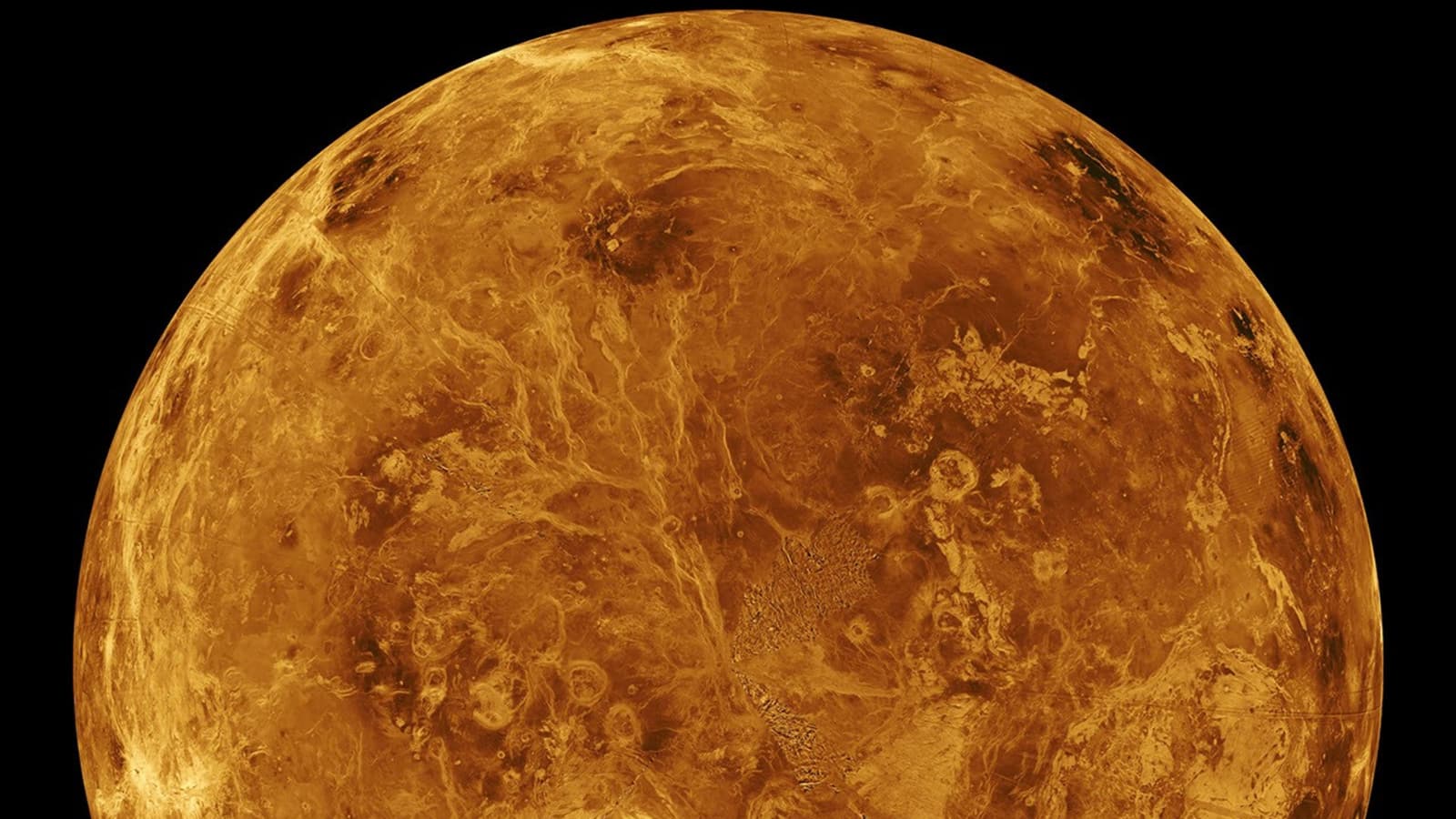
A Planet That Should Have Been Like Ours
If you were drawing up the solar system from scratch and wanted to pick its two most similar planets, you would not hesitate. You would choose Earth and Venus.
The two worlds formed in the same region of the protoplanetary disk, from the same reservoir of dust and gas, around the same young Sun, in the same geological instant. Venus's diameter is about 95 percent of Earth's. Its mass is about 82 percent. Its density is nearly identical. Both have iron-rich cores, silicate mantles, and silicate crusts — the planetary architecture of a rocky world with working plumbing underneath.
Yet if you transported a human from the surface of the Earth to the surface of Venus without protection, almost everything about that person would be wrong within seconds. The ambient temperature at the Venusian surface averages 465 degrees Celsius — hot enough to melt lead. The atmospheric pressure is about 92 times the pressure of Earth's atmosphere at sea level — equivalent to being nearly a kilometer underwater. The air is 96.5 percent carbon dioxide, and the clouds that shroud the planet are made not of water, but of sulfuric acid.
So what happened? How did two planets that started as near-identical twins end up so radically different?
By nearly every measurable criterion of planetary birth, Venus and Earth are the same world. And then you look at them today, and you would think they had nothing in common at all.
The Runaway Greenhouse
The obvious first suspect is the Sun. Venus orbits the Sun at approximately 0.72 astronomical units, compared with Earth's 1.00. That closer orbit means Venus receives roughly twice as much solar radiation as Earth does. When the Sun was younger, some 4 billion years ago, that effect was smaller — the young Sun was about 30 percent fainter than it is today — but even so, Venus has always lived in a more aggressive thermal environment.
The conventional explanation of the Venusian greenhouse goes like this: early in its history, Venus may well have had oceans of liquid water, as Earth did. But as the Sun slowly brightened over billions of years, the radiation striking Venus's surface intensified. That extra energy evaporated surface water into the atmosphere as vapor. Water vapor is itself a potent greenhouse gas, which trapped more heat, which evaporated more water, which trapped more heat. The feedback ran away.
Eventually, solar ultraviolet light at the top of the Venusian atmosphere broke apart the water molecules that drifted up into it. The hydrogen was light enough to escape into space; the oxygen combined with other compounds on the surface. The oceans were quite literally unmade, molecule by molecule, and shipped off into the void.
The signature of this process is still detectable today. The Venusian atmosphere contains an unusually high ratio of deuterium to ordinary hydrogen — roughly 150 times what is seen on Earth. Deuterium, the heavier isotope of hydrogen, is less likely than ordinary hydrogen to escape to space, so it accumulates over time in a world that is losing water. Venus's atmosphere is a crime scene, and the isotope ratios are the forensic evidence.
So far, so familiar. But this story is incomplete. A runaway greenhouse explains why Venus lost its oceans. It does not, by itself, explain the composition or total volume of the atmosphere we see today.
An Engine That Used to Run
On Earth, the atmosphere is constantly being replenished and recycled by an engine that most of us never think about: plate tectonics.
The outer shell of our planet is broken into rigid plates that move, collide, and dive beneath one another along subduction zones. Every time an oceanic plate slides into the mantle, it carries with it sediments, minerals, and water. Volcanoes above the subduction zone erupt the volatile elements back out as gas — a cycle that has pulsed through Earth's crust for billions of years, venting carbon dioxide and other gases, mediating the climate, and keeping the mantle churning.
Our plate tectonics are not only geology. They are climate control. They are the reason Earth's carbon dioxide levels stayed in a range compatible with liquid water over hundreds of millions of years. And they appear to be the single most important reason Earth's atmosphere is thin, breathable, and stable.
Venus has no plate tectonics today. Its lithosphere behaves as a single rigid lid, a single plate that covers the entire planet — a condition planetary scientists call the "stagnant lid regime." Heat from the deep interior does not escape through subduction. Instead, it builds up until it vents catastrophically through massive volcanoes. This regime is far less efficient at cycling gases between the atmosphere and the interior. It is also a regime under which Venus's present-day atmosphere should not exist in the form it does.
The engine that makes Earth habitable is not the Sun. It is what happens under our feet.
The 2023 Paper That Rewrote the Story
In October 2023, a team led by Matthew Weller of the Lunar and Planetary Institute published a paper in Nature Astronomy with a surprising claim: the Venusian atmosphere, as we observe it today, cannot be explained by a planet that has been in stagnant lid regime since it formed. The numbers do not add up.
Specifically, Weller and his colleagues looked at two of the major components of Venus's modern atmosphere: nitrogen (about 3.5 percent by volume, but a significant mass) and carbon dioxide (about 96.5 percent). They modeled the volcanic outgassing rates that would be required to produce those observed abundances under various tectonic regimes. A single-plate stagnant lid, acting alone from the planet's formation to today, could not produce enough nitrogen to match what we detect. The atmosphere we see demands something more efficient, something more Earth-like, for at least a portion of Venus's history.
Their conclusion was direct. For at least about a billion years after Venus formed — roughly between 4.5 and 3.5 billion years ago — the planet must have had an Earth-like plate tectonics regime, in which mobile plates subducted, mantle material cycled, and volatiles outgassed at rates comparable to our own planet.
In other words: at the same moment life was first emerging on Earth, Venus had a functioning tectonic engine too. For roughly a billion years, there were two tectonically active rocky planets in the inner solar system, orbiting the same star, working in the same way. Then one of them stopped.
Why the Engine Stopped
The reason Venus's plate tectonics ceased remains an open question, but Weller's team and others have proposed a plausible mechanism that follows from the thermodynamics.
Plate tectonics requires a lithosphere that is cool and brittle enough to fracture into plates, but also a mantle that is hot enough to drive the convection underneath. It requires, crucially, water — because water weakens rock, lowers the strength of the lithosphere, and lubricates the subduction zones where plates dive back into the mantle. Without water, rocks become stronger and stiffer, and the movement of plates stalls.
As Venus's early oceans evaporated and were stripped away by solar ultraviolet, water left both the surface and the interior. The mantle dried out. The lithosphere stiffened. And the tectonic engine, starved of its lubricant, eventually ground to a halt. Once it did, volcanic outgassing shifted from the steady, distributed regime of plate tectonics to the occasional, catastrophic regime of the stagnant lid. Carbon dioxide built up in the atmosphere. Surface temperatures climbed. What was already a hot world became the hottest world.
If this picture is correct, then Venus's modern state is not the result of one thing going wrong. It is the result of a chain reaction — solar brightening, ocean loss, mantle desiccation, plate tectonic collapse, atmospheric build-up, runaway greenhouse — in which each step locked in the next. Once the oceans were gone, the tectonics died. Once the tectonics died, the atmosphere ran away.
The Uncomfortable Implication
For decades, planetary scientists have treated habitability as a question of a planet's location: was it in the so-called "habitable zone" around its star, where liquid water could exist on its surface? The Weller paper, together with a growing body of similar work, is nudging the question in a different direction.
Habitability is not a property a planet has or does not have. It is a state a planet can lose. Venus sits at the inner edge of the Sun's habitable zone today; Earth sits comfortably within it. But both planets began in essentially the same zone, with the same ingredients and a similar size. For a billion years, both had the same habitability-sustaining tectonic engine. The difference between them is not that one was born wrong. The difference is that one aged wrong.
That framing has implications that extend well past our own solar system. Astronomers have so far cataloged thousands of exoplanets in the habitable zones of other stars. How many of those worlds are in a stage of their evolution where life could flourish, and how many have already aged out of that stage — or will soon? We may not yet have tools precise enough to tell. But the sample size in our own solar system has just expanded. It is no longer the case that we know of one rocky world where plate tectonics can exist. We know of at least two — one that still has them, and one that used to.
Looking Again, More Carefully
Three missions to Venus are in active development. NASA's DAVINCI, targeting a launch in the late 2020s, will send a probe through the Venusian atmosphere, directly sampling its composition as it descends. NASA's VERITAS and ESA's EnVision, each targeting the early 2030s, will orbit Venus with high-resolution radar and spectrometers, mapping the surface and its geology in detail we have never had.
Among the highest-priority questions these missions will attempt to answer is whether remnant evidence of ancient plate tectonics can be identified in the Venusian crust — fossil suture zones, ancient rift systems, traces of the subducted past. If they find them, the Weller picture will move from well-argued model to documented planetary history. If they do not, we will need a different explanation for the same atmospheric puzzle.
Either way, we will have learned something essential about why Earth is habitable, and how fragile that condition turns out to be.
Venus is not the planet Earth could never become. It is the planet Earth used to be on track to avoid.
Frequently Asked Questions
Why is Venus hotter than Mercury if it is farther from the Sun?
Mercury has essentially no atmosphere, so even though its sunlit side can reach about 430 degrees Celsius, heat is not retained and the night side plunges below -170 degrees Celsius. Venus has a thick carbon dioxide atmosphere with a pressure 92 times Earth's, which traps heat efficiently. Venus's average surface temperature of about 465 degrees Celsius is higher than Mercury's peak and is essentially uniform across day, night, poles, and equator.
Did Venus really once have oceans?
Most modern climate models of early Venus support the existence of liquid water at the surface for at least hundreds of millions of years, and possibly as long as two billion years. The strongest present-day evidence is the unusually high ratio of deuterium to ordinary hydrogen in the Venusian atmosphere, about 150 times the ratio on Earth — a signature consistent with a planet that has lost substantial amounts of water over geological time.
What did the 2023 paper actually prove?
The team led by Matthew Weller at the Lunar and Planetary Institute showed that Venus's current atmospheric abundances of nitrogen and carbon dioxide cannot be reproduced by a planet that has been in a single-plate stagnant-lid tectonic regime for its entire history. Reproducing the observed atmospheric composition requires an earlier phase of plate tectonics — mobile, Earth-like subduction — lasting at least about a billion years, before transitioning to the stagnant lid regime we see today.
Why would Venus's plate tectonics have stopped?
Plate tectonics require water in the mantle to keep rocks weak enough to fracture and subduct. As Venus lost its surface water to a runaway greenhouse and solar stripping, the interior dried out. Without water, the Venusian lithosphere became too strong to break into mobile plates. The tectonic engine that had operated for about a billion years gradually stalled, and Venus settled into the stagnant lid regime that dominates today.
Could Earth end up like Venus?
In the very long term, yes. The Sun will continue brightening over the next billion to two billion years, at which point Earth's own runaway greenhouse is expected to become thermodynamically inevitable. Well before that, however, Earth's plate tectonics will remain active, and Earth will lose its habitability along a different trajectory than Venus did. The Venus case is a warning about the end-state of inner-zone rocky planets, not an imminent forecast.
Which missions are currently planned for Venus?
Three missions are in development as of 2026. NASA's DAVINCI will send a descent probe through the Venusian atmosphere. NASA's VERITAS will orbit the planet with high-resolution radar and near-infrared spectroscopy. ESA's EnVision will combine radar, spectrometry, and subsurface sounding from orbit. All three target the late 2020s through early 2030s and will, among other goals, directly probe Venus's surface for evidence of ancient plate tectonics.
Sources
- Weller, M. B., Evans, A. J., Ibarra, D. E. & Johnson, A. V. "Venus's atmospheric nitrogen explained by ancient plate tectonics." Nature Astronomy 7, 1436 (2023). nature.com
- NASA — Venus Fact Sheet. NASA Goddard Space Flight Center. nssdc.gsfc.nasa.gov
- NASA DAVINCI mission overview. nasa.gov
- NASA VERITAS mission overview. jpl.nasa.gov
- ESA EnVision mission overview. esa.int
- Donahue, T. M. & Hodges, R. R. "Past and present water budget of Venus." Journal of Geophysical Research (1992) — the foundational deuterium-to-hydrogen measurement.
- Brown University press release on the Weller et al. finding. brown.edu
- Cover image: NASA/JPL-Caltech — Magellan radar mosaic of Venus's surface. Public domain.